Pelvic Floor Training: What Actually Changes It?
Quick Answer: Isolated Kegels help some people and do nothing for others, because a pelvic floor can be weak, overly tight, or poorly coordinated — and squeezing only addresses the first. Breathing mechanics and gradual loading usually change more than repetitions do.
You were told to do Kegels. You did them, diligently, for months. Nothing much changed.
That’s a common enough outcome that it’s worth understanding why, rather than assuming you did them wrong.
This is general information, not medical advice. A pelvic floor physiotherapist can assess what’s actually happening.

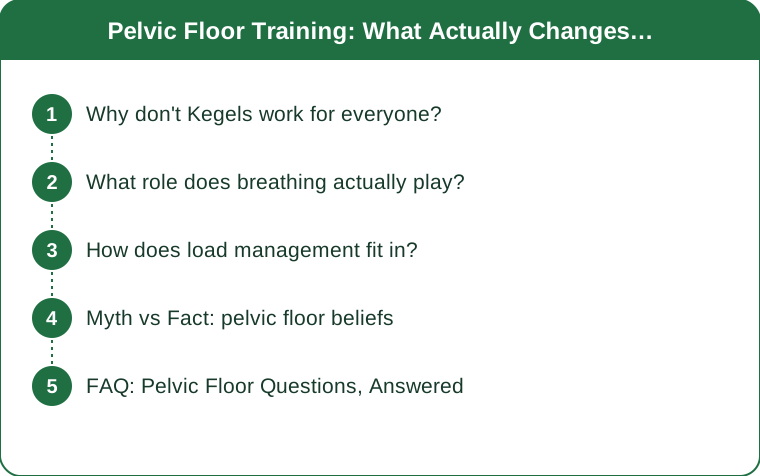
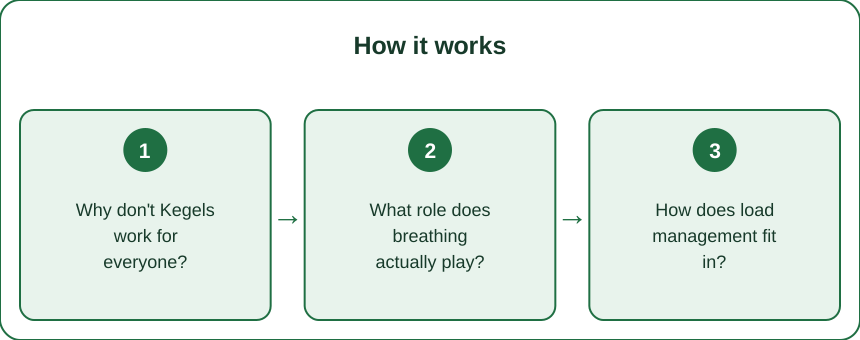
Why don’t Kegels work for everyone?
Because they treat one problem, and there are at least three.
A weak pelvic floor genuinely benefits from strengthening. Contractions build it, the same way they build any muscle.
An overactive or tight pelvic floor is already holding too much tension. Adding contractions to a muscle that can’t fully release makes symptoms worse, not better — and this presentation is far more common than people realize, particularly with pain, urgency, or a sense of heaviness.
A poorly coordinated pelvic floor has adequate strength but fires at the wrong time. It should engage automatically before you cough, lift, or land. If the timing is off, no amount of deliberate squeezing at your desk fixes it.
How do I know which one I have?
Honestly, you usually can’t from symptoms alone — leaking can result from all three. This is the strongest argument for an assessment with a pelvic health physiotherapist rather than guessing.
What’s the harm in doing Kegels anyway?
If your floor is overactive, months of added contraction can increase pain and worsen the symptoms you started with. It’s not neutral.
What role does breathing actually play?
A large one, and it’s the piece most often missing.
Your diaphragm and pelvic floor move together as a pressure system. Breathe in, the diaphragm descends, the pelvic floor lengthens. Breathe out, both come back up. They’re mechanically linked whether or not you’re thinking about them.
When breathing goes wrong — chest breathing, breath holding, gripping the abdominals constantly — that coordination breaks down. The pelvic floor either stops moving through its range or fights against downward pressure it wasn’t designed to resist alone.
The practical starting point is a 360-degree breath: lying down, hands on the lower ribs, breathe so the ribs expand sideways rather than the chest lifting. Feel the pelvic floor lengthen on the inhale, release on the exhale. Five minutes, most days.
That’s not a warm-up for the real work. For many people it is the work, at least for the first several weeks.
Should I hold my breath when lifting something heavy?
A brief brace is normal and appropriate for genuinely heavy loads. What causes trouble is holding a hard brace for everything — carrying a toddler, standing up, moving around the house — which keeps pressure pushing downward all day.

How does load management fit in?
The pelvic floor is part of a system that manages intra-abdominal pressure. Every time you lift, cough, or land, pressure spikes and something has to absorb it.
Progression works the same way it does for any tissue:
- Breathing and coordination, unloaded, lying down
- Bodyweight movement with attention to breath — sit to stand, gentle bridges
- Light external load, exhaling on the effort
- Progressive loading, adding weight in small steps
- Impact, last and most gradually
The common mistake is jumping to step 5 because a calendar said twelve weeks postpartum. Tissue readiness doesn’t follow a calendar, and returning to running is one of the most demanding things you can ask of a recovering pelvic floor.
What symptoms mean I’ve progressed too fast?
Leaking that wasn’t there before, a feeling of heaviness or dragging in the pelvis, or pain. Any of those means step back a level — not push through.
How long should each stage take?
There’s no fixed timeline, and that’s the honest answer rather than an evasion. Some people move through the early stages in two weeks; others need two months on breathing alone. The marker for progressing is that the current stage produces no symptoms in the 24 hours afterward — not that a certain number of weeks have passed.
Myth vs Fact: pelvic floor beliefs
Myth: Stopping your urine midstream is a good exercise. Fact: It’s occasionally suggested as a one-off way to locate the muscles, but repeated as an exercise it can interfere with normal bladder emptying. Don’t use it as training.
Myth: Leaking is a normal part of being a mother. Fact: It’s common, which is not the same as normal or untreatable. Studies of pelvic floor muscle training consistently show meaningful improvement rates. Accepting it as permanent is the actual mistake.
Myth: More repetitions produce faster results. Fact: For an overactive floor, more reps make it worse. For a weak one, quality and full relaxation between contractions matter more than volume. The release is as much of the exercise as the squeeze.
Myth: It’s too late if you’re years postpartum. Fact: Muscle responds to appropriate training at any point. Improvements are regularly seen in women decades past childbirth.
FAQ: Pelvic Floor Questions, Answered
How long before I notice a difference?
With an appropriate program, many people notice change in 6-12 weeks, and continued improvement well beyond that. If nothing has shifted after three consistent months, that’s a strong signal the program isn’t matched to the problem — get assessed rather than doubling the reps.
Can I train the pelvic floor while pregnant?
Generally yes, and it’s often recommended, but pregnancy changes what’s appropriate as it progresses. This is worth discussing with your maternity care provider or a pelvic health physio rather than following a generic program.
Do weighted devices and trainers help?
They can, for a genuinely weak floor that has been assessed as such. They’re actively unhelpful for an overactive one. The device isn’t the issue — using one without knowing which problem you have is.
Can I do this alongside regular strength training?
Yes, and in most cases you should. A pelvic floor works as part of your whole system, and general strength training — particularly hip and glute work — supports it. What matters is progressing load in a way that your floor can manage, not avoiding load altogether.
Does a c-section mean my pelvic floor is unaffected?
No. Pregnancy itself loads the pelvic floor for nine months regardless of delivery method, and pelvic floor symptoms are common after cesarean birth too. The delivery route changes some risks but doesn’t exempt you from the ones that come from carrying the pregnancy.
TL;DR:
- A pelvic floor can be weak, tight, or poorly coordinated; Kegels only address the first.
- Diaphragm and pelvic floor work as one pressure system — 360-degree breathing is often the highest-yield starting point.
- Progress load in stages and treat impact as the last step, not a twelve-week milestone.
- Common isn’t the same as normal — leaking responds to appropriate training.
The reason Kegels disappoint so many people isn’t effort. It’s that the exercise was matched to a guess. An assessment turns months of hopeful squeezing into a program aimed at what’s actually going on.
This is general information, not medical advice. See a pelvic health physiotherapist or your care provider for assessment.
See It in Motion
Seen here: Maternity Capris with Side Pockets — shop it on bubblelime.com
Keep Reading
This article is for general informational purposes only and is not medical advice. It is not a substitute for professional diagnosis or treatment. Always consult a qualified healthcare provider about your individual situation, especially before making significant changes to your diet or exercise routine.