Coning During Pregnancy: What It Means and What to Change
Quick Answer: Coning, also called doming, is when the abdominal midline pushes outward into a visible ridge during effort, meaning the connective tissue between the abdominal muscles is not managing the pressure being generated. It is a signal to modify the exercise, not evidence of injury. Reduce the load, exhale through the effort, work in a range where the midline stays flat, and shift toward exercises that build tension without high intra-abdominal pressure. Coning does not reliably predict diastasis recti, and repeatedly training through it is not advisable.
Someone points out a ridge down the middle of your bump during a plank and the reaction is usually alarm. That reaction is understandable and mostly unwarranted.
Coning is a load management signal. What matters is what you do next, not that it happened.

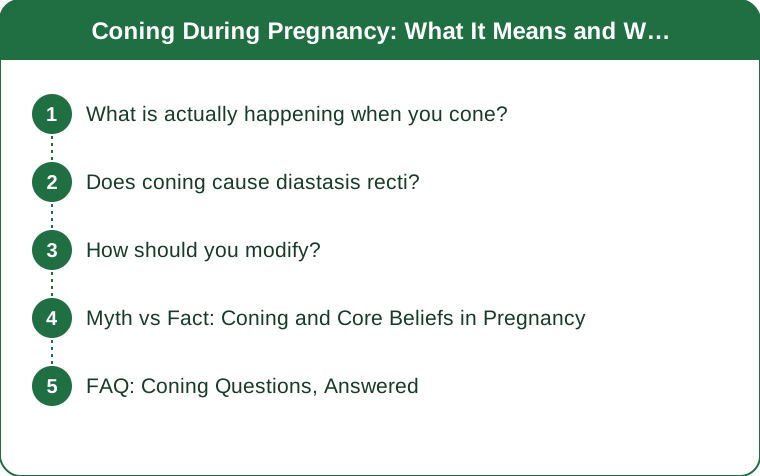
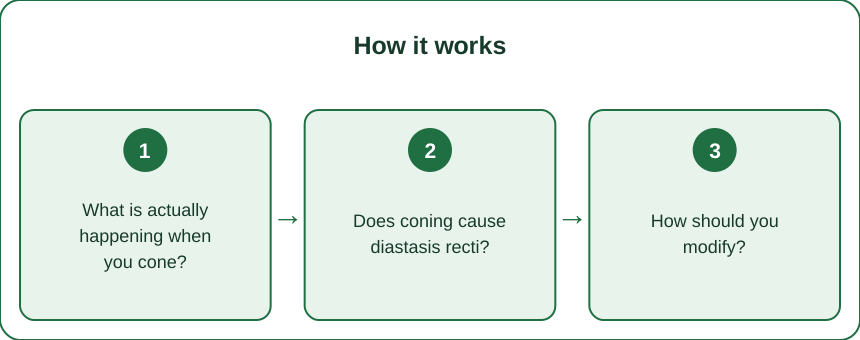
What is actually happening when you cone?
Pressure inside your abdomen is exceeding your midline’s current ability to transfer it laterally.
Your abdominal wall works as a system. The rectus abdominis runs vertically on either side of the linea alba, the connective tissue seam down the middle. The obliques and transverse abdominis run at angles and connect into that seam.
When the system works well: the deeper layers create tension across the midline, distributing pressure sideways, and the abdominal wall stays relatively flat under load.
When pressure exceeds that capacity: the path of least resistance is forward through the linea alba, which pushes outward into a visible ridge.
Pregnancy changes the equation in three ways:
- The linea alba widens and softens under hormonal influence, particularly relaxin, which is normal and necessary
- The growing uterus stretches the abdominal wall, reducing the muscles’ mechanical advantage
- Intra-abdominal volume increases, so the same effort produces more pressure
Which is why coning appears in the second and third trimesters in people who never saw it before, doing exercises they have always done. Your abdominal wall has not weakened. The task has changed.
Where you see it most: sit-ups and crunches, front planks late in pregnancy, sitting up from lying flat, and heavy overhead lifting.
Does coning cause diastasis recti?
The honest answer is that the relationship is less certain than commonly presented.
What is well established: the majority of pregnant people develop some degree of abdominal separation by the third trimester. This is a normal adaptation, not a pathology, and it resolves substantially in most people within the first year postpartum.
What is not established: that coning during exercise causes or worsens lasting separation. There is limited direct evidence either way, and the causal claim is widely repeated with more confidence than the data support.
What is reasonable to conclude:
- Coning indicates the midline is not managing the current load, which is useful information
- Repeatedly loading tissue beyond its capacity is not a good general principle, so modifying is sensible
- Panicking about a single instance of coning is not warranted
- Function matters more than the width of any gap. Postpartum research consistently finds that the ability to generate tension across the midline predicts symptoms better than the measured separation does.
The practical framing that helps most: treat coning like a form breakdown in any other lift. If your back rounds during a deadlift, you reduce the weight. You do not conclude you have injured your spine, and you also do not do another ten reps.

How should you modify?
Five adjustments, roughly in order of what to try first.
1. Change your breathing. Exhale during the effort phase, rather than holding your breath. Breath holding raises intra-abdominal pressure substantially, and this single change resolves coning in many exercises without altering anything else.
2. Reduce the range. In a movement where coning appears at a specific point, work in the range where the midline stays flat. In a plank, that might mean elevating your hands. In a leg lowering exercise, stopping higher.
3. Reduce the load or the leverage. Longer levers create more demand. Bent knees instead of straight legs, an incline plank instead of flat, a lighter weight held closer to the body.
4. Change the exercise. Some movements are simply poorly suited to later pregnancy:
- Replace crunches and sit-ups with standing or side-lying core work, bird dogs, and pallof presses
- Replace front planks with incline planks, side planks, or hands-elevated versions
- Replace double leg lowering with single leg versions or heel slides
- Keep loaded carries, squats, and rows, which build real core strength with better pressure management
5. Use your hand as feedback. Place a hand flat on your midline during core work. You can feel coning before you can see it, and this makes self-monitoring practical without a mirror.
What to keep doing: strength training generally, walking, and most conditioning. The recommendation is to modify specific exercises, not to stop training. Regular exercise in pregnancy has substantial documented benefits, and the alternative of avoiding core work entirely leaves you less prepared for birth and recovery.
Myth vs Fact: Coning and Core Beliefs in Pregnancy
Myth: Coning means you have damaged your abdominal wall. Fact: It means pressure exceeded what your midline can transfer at that moment. It is a real-time load signal, and there is limited evidence it causes lasting damage on its own.
Myth: You should stop all core work if you cone. Fact: You should modify. Abandoning core training entirely leaves you weaker for labour and recovery. Standing, side-lying, and anti-rotation work usually remains available.
Myth: Diastasis recti means your abs have torn. Fact: Nothing tears. The linea alba stretches and thins, widening the distance between the muscle bellies. It is an adaptation to accommodate a growing uterus.
Myth: A narrow gap postpartum is the goal. Fact: Function predicts symptoms better than gap width. Someone with a wider gap and good tension generation often has fewer problems than someone with a narrow gap and poor control.
Myth: Sucking your stomach in protects your midline. Fact: Constant abdominal gripping raises baseline pressure and often pushes it downward onto the pelvic floor. Relaxed, coordinated breathing with pressure managed during effort is the goal.
Myth: You can prevent diastasis recti entirely with the right exercises. Fact: Some separation is near-universal in the third trimester and is not preventable, nor should it be. What you can influence is how well you manage pressure and how efficiently function returns afterward.
Seasonal note: late summer heat adds a practical layer here. Pregnant exercisers overheat faster, and fatigue reduces pressure management, which makes coning more likely late in a hot session than it would be in the same session in October. Training earlier in the day, keeping sessions shorter in the heat, and building in more rest between sets are reasonable adjustments for the next few weeks.
This is general information, not medical advice. Work with your maternity care provider, and a pelvic health physiotherapist if available, particularly if you have pain, leaking, a feeling of heaviness in the pelvis, or coning that persists at low loads.
FAQ: Coning Questions, Answered
Is coning during pregnancy dangerous?
It is a signal that pressure exceeded what your midline can currently transfer, not evidence of injury. Modify the exercise rather than pushing through, and do not panic about a single instance.
What exercises should I avoid if I am coning?
Crunches, sit-ups, double leg lowering, and flat front planks are the usual culprits later in pregnancy. Replace them with standing core work, side planks, bird dogs, pallof presses, and loaded carries.
Does coning cause diastasis recti?
The causal link is less established than commonly stated. Some separation is near-universal by the third trimester regardless. Modifying when you cone is sensible, and treating it as proof of damage is not supported.
How do I know if I am coning without a mirror?
Place a hand flat on your midline during core work. You can feel the ridge push into your palm before it is visible, which makes it a practical self-check during any exercise.
TL;DR:
- Coning means intra-abdominal pressure exceeded what your midline can transfer laterally. It is load feedback, not injury.
- Exhale through the effort first. Breath holding raises pressure, and fixing that alone resolves coning in many exercises.
- Then reduce range, reduce leverage, and swap crunches and flat planks for standing, side-lying, and anti-rotation work.
- Some separation by the third trimester is near-universal and normal. Function predicts symptoms better than gap width.
Keep training and modify the specific exercise. A hand flat on your midline is the simplest monitoring tool you have.
See It in Motion
Seen here: Maternity Capris with Side Pockets — shop it on bubblelime.com
Keep Reading
This article is for general informational purposes only and is not medical advice. It is not a substitute for professional diagnosis or treatment. Always consult a qualified healthcare provider about your individual situation, especially before making significant changes to your diet or exercise routine.