Second Trimester Workouts: Every Question You Have, Answered
Quick Answer: In the second trimester most people feel their best and can continue training with a few specific adjustments: stop lying flat on your back for extended periods, avoid anything with fall or impact-to-abdomen risk, use the talk test rather than heart rate caps, and watch for coning at the midline. Current guidance supports around 150 minutes of moderate activity weekly in an uncomplicated pregnancy. Everything below assumes your own clinician has cleared you to exercise, which is the necessary first step.
The nausea has lifted, the energy is back, and suddenly everyone has an opinion.
Here is what the actual guidance says, answered in the order people ask.

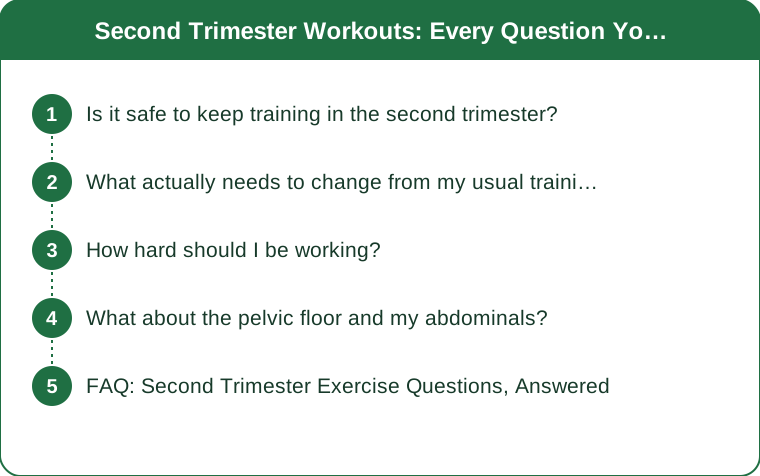
Is it safe to keep training in the second trimester?
For an uncomplicated pregnancy with clinician clearance, yes — and the guidance is more encouraging than most people expect.
Major obstetric bodies recommend exercise in pregnancy. Around 150 minutes of moderate-intensity activity per week is the commonly cited target for uncomplicated pregnancies, spread across most days.
Continuing is easier than starting, but starting is fine too. Previously inactive people are encouraged to begin, with a gradual build rather than jumping into what they used to do years ago.
Benefits are well documented. Reduced risk of gestational diabetes and hypertensive disorders, better mood, less back pain, and easier postpartum recovery are all associated with regular activity in pregnancy.
The second trimester is usually the best window. First-trimester fatigue and nausea have often settled, and the physical constraints of the third trimester have not yet arrived.
Some conditions change the picture entirely. Placenta praevia after a certain gestation, pre-eclampsia, cervical insufficiency, persistent bleeding, ruptured membranes and certain cardiac or lung conditions are all reasons exercise may be restricted. Your clinician’s advice supersedes anything here.
Stop and seek advice for warning signs. Vaginal bleeding, regular painful contractions, fluid leakage, chest pain, calf pain or swelling, dizziness or headache before exercise all warrant stopping and contacting your care provider. This is general information, not medical advice.
What actually needs to change from my usual training?
Fewer things than you would guess, but the ones that change matter.
Limit extended time lying flat on your back. From around the middle of pregnancy, the growing uterus can compress the vena cava in supine positions, reducing blood return. Brief periods are generally fine; long sets and long stretches on your back are usually modified. Use an incline.
Avoid activities with fall risk or abdominal contact. Contact sports, skiing, horse riding, and anything where losing balance is likely. Your centre of gravity is shifting and balance genuinely changes.
Skip scuba diving entirely. One of the few absolute contraindications.
Be careful with heat. Avoid hot yoga, saunas and exercising in high heat and humidity, particularly in the first trimester but as a general principle throughout.
Modify the abdominal work. Traditional crunches and sit-ups are usually swapped for deep core work — breathing-based exercises, side planks, bird dogs, pallof presses.
Watch for coning or doming at the midline. A visible ridge along the centre of the abdomen during effort means the load is too much for your current abdominal wall. Reduce the load or change the exercise rather than pushing through.
Adjust range and grip as your body changes. Ligament laxity increases, so very deep end-range stretching is generally discouraged.
Keep lifting, with sensible loads. Resistance training is supported in pregnancy. Most people reduce maximal effort and avoid prolonged breath-holding, exhaling on exertion instead.

How hard should I be working?
Use the talk test, not a heart rate number.
Heart rate caps have largely been abandoned. The old advice to stay under 140 beats per minute is outdated, because resting and exercising heart rate change substantially in pregnancy and vary hugely between individuals.
The talk test is the current practical standard. You should be able to hold a conversation while exercising. If you cannot speak in sentences, ease off.
Rate of perceived exertion works well too. Aiming for a moderate effort — around 12 to 14 on a 6 to 20 scale — is a common recommendation.
Previously active people can generally maintain higher intensities. Athletes who trained at high intensity before pregnancy often continue to, with clinician involvement. Guidance for the general population is not the same as guidance for a trained athlete.
Expect your capacity to vary day to day. More than it used to, and more than seems reasonable. Blood volume, sleep, nausea and iron status all fluctuate.
Do not train to failure. Leave several reps in reserve. Maximal effort involves breath-holding and pressure spikes that are best avoided.
Hydrate more than before. Blood volume increases substantially and thermoregulation changes. Dehydration arrives faster.
Stop if something feels wrong. Trust that instinct over any protocol.
What about the pelvic floor and my abdominals?
This is where a bit of specific work pays off enormously, both now and afterwards.
Train the pelvic floor throughout. Pelvic floor muscle training in pregnancy is associated with reduced incontinence during and after pregnancy. It is one of the highest-value things you can do.
Both contraction and relaxation matter. A floor that cannot relax is as problematic as one that is weak, and full release is part of the exercise.
Learn to exhale on effort. Breathing out during the hard part of a movement manages intra-abdominal pressure and protects both the pelvic floor and the abdominal wall.
Some abdominal separation is normal and expected. Nearly all pregnancies involve some degree of separation of the rectus abdominis by the third trimester. It is a normal adaptation, not an injury.
Manage the load rather than avoiding all core work. Deep core and breathing-based work is beneficial. It is high-load flexion and anything producing coning that gets modified.
Side planks and bird dogs are the usual substitutes. They train the abdominal wall without the flexion load and the pressure spike.
A pelvic health physiotherapist is worth seeing if you can. One appointment mid-pregnancy is high value, particularly if you have any leaking, heaviness or pain.
Report pelvic heaviness or dragging. A sensation of heaviness or pressure in the vagina during or after exercise is worth reporting to your clinician rather than working through.
Seasonal note: if you were exercising outdoors through summer, cooler autumn weather actually helps with the overheating concern — but wet leaves and uneven ground raise the fall risk that matters more now. Move to stable surfaces as the weather turns.
FAQ: Second Trimester Exercise Questions, Answered
Can I still run?
Many people continue running through the second trimester comfortably. Pelvic heaviness, leaking or pain are signals to modify. There is no requirement to stop at any particular week in an uncomplicated pregnancy.
Can I lift heavy?
Resistance training is supported. Most people reduce toward moderate loads, avoid maximal effort and breath-holding, and exhale on exertion.
What about planks?
Generally fine if there is no coning and no pelvic floor symptoms. Incline planks reduce the load as pregnancy progresses.
Is it too late to start?
No. Previously inactive people are encouraged to begin, starting gently and building gradually with clinician clearance.
How do I know if I am doing too much?
Excessive fatigue that does not resolve, pelvic heaviness, leaking, coning, or feeling worse rather than better after sessions are the practical signals.
Should I use a support belt?
Some people find one helpful for pelvic girdle pain. It is worth trying with guidance from a physiotherapist rather than as a default purchase.
TL;DR:
- Around 150 minutes of moderate activity weekly is the general guidance for an uncomplicated pregnancy — with clinician clearance first.
- Change: limit extended supine work, avoid fall and impact risk, avoid overheating and scuba diving.
- Use the talk test, not a heart rate cap. Leave reps in reserve.
- Watch for coning at the midline and modify rather than push through.
- Pelvic floor training is one of the highest-value things you can do now.
Stop and contact your care provider for bleeding, contractions, fluid leakage, chest pain or calf pain. Everything else is adjustable.
See It in Motion
Seen here: Maternity Capris with Side Pockets — shop it on bubblelime.com
Keep Reading
This article is for general informational purposes only and is not medical advice. It is not a substitute for professional diagnosis or treatment. Always consult a qualified healthcare provider about your individual situation, especially before making significant changes to your diet or exercise routine.